

Section 10: Buying Calls & Puts
Long Calls & Long Puts
BEGINNER LEVEL
10/7/20256 min read
1. Buying calls and puts
Now that you understand what options are, how the market works, and how options are priced, it's time to learn some practical strategies. These are the building blocks of options trading, allowing you to participate in the market with defined goals and risk profiles.
We'll focus on three fundamental strategies: buying calls, buying puts, and selling covered calls.
1.1 Buying Calls: ُExpecting on an Upside Move (Long Call)
Buying a call option is the most straightforward way to use options to profit from a stock price increase. It's often used as an alternative to buying the stock outright, offering significant leverage.
What it is: You purchase a call option contract, giving you the right to buy 100 shares of the underlying stock at a specific strike price on or before the expiration date.
When to use it (Market View): You are bullish on the underlying stock. You believe its price will increase significantly (above the strike price) before the option expires.
Why use it over buying stock?
Leverage: You control 100 shares of stock for a much smaller capital outlay (the premium) than buying 100 shares directly. This means higher potential percentage returns if your prediction is correct.
Defined Risk: Your maximum loss is limited to the premium you pay for the option.
Risk and Reward Profile:
Maximum Risk: Limited to the premium paid (per contract).
Maximum Reward: Unlimited. As the stock price rises, the call option's intrinsic value increases, and it can theoretically go up indefinitely.
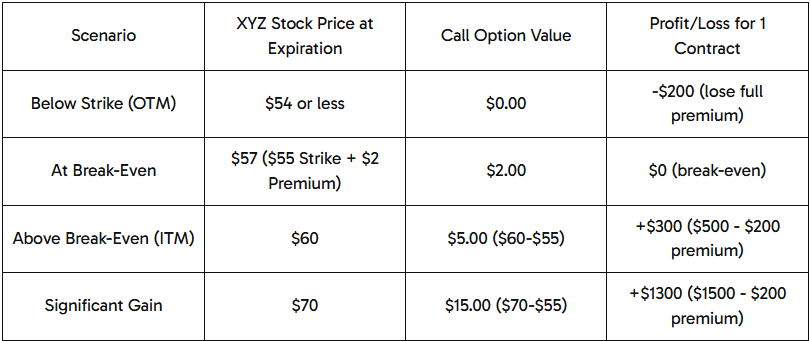
Break-Even Point: Strike Price + Premium Paid
Example: Buying a Call Option
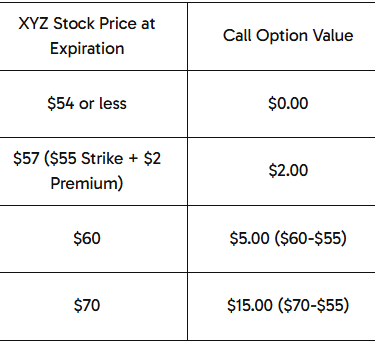
Let's say XYZ stock is currently trading at $50 per share. You are very bullish and expect it to go up significantly.
You buy 1 XYZ $55 Call option expiring in 3 months for a premium of $2.00 per share (total cost: $2.00 x 100 shares = $200).


Important Considerations for Buying Calls:
Time Decay: This is working against you. The stock needs to move up before the option loses too much time value.
Strike Price Choice: Choosing a higher strike (more OTM) means a lower premium but requires a larger move in the stock to become profitable. Choosing a lower strike (more ITM or ATM) means a higher premium but requires a smaller move.
1.2 Buying Puts: Expecting a Downside Move (Long Put)
Risk and Reward Profile:
Maximum Risk: Limited to the premium paid (per contract).
Maximum Reward: Substantial, as a stock can fall to $0 (though it's capped at the strike price minus premium paid).
Break-Even Point: Strike Price - Premium Paid
Example: Buying a Put Option
Let's say ABC stock is currently trading at $100 per share. You are bearish and expect it to drop.
You buy 1 ABC $95 Put option expiring in 3 months for a premium of $3.00 per share (total cost: $3.00 x 100 shares = $300).


Important Considerations for Buying Puts:
Time Decay: Just like calls, time decay works against put buyers. The stock needs to fall quickly enough.
Strike Price Choice: Similar to calls, a lower strike (more OTM) is cheaper but requires a larger drop. A higher strike (more ITM or ATM) is more expensive but requires a smaller drop to be profitable.
Buying a put option is the primary way to use options to profit from a falling stock price. It's often used for speculation or as an "insurance policy" for stocks you own (which we'll discuss next).
What it is: You purchase a put option contract, giving you the right to sell 100 shares of the underlying stock at a specific strike price on or before the expiration date.
When to use it (Market View): You are bearish on the underlying stock. You believe its price will decrease significantly (below the strike price) before the option expires.
Why use it over Short Selling Stock?
Defined Risk: Your maximum loss is limited to the premium you pay for the option. This is a huge advantage over short selling stock, which has theoretically unlimited risk.
Leverage: Similar to calls, you control 100 shares for a smaller upfront cost.
1. Buying calls and puts
Now that you understand what options are, how the market works, and how options are priced, it's time to learn some practical strategies. These are the building blocks of options trading, allowing you to participate in the market with defined goals and risk profiles.
We'll focus on three fundamental strategies: buying calls, buying puts, and selling covered calls.
1.1 Buying Calls: ُExpecting on an Upside Move (Long Call)
Buying a call option is the most straightforward way to use options to profit from a stock price increase. It's often used as an alternative to buying the stock outright, offering significant leverage.
What it is: You purchase a call option contract, giving you the right to buy 100 shares of the underlying stock at a specific strike price on or before the expiration date.
When to use it (Market View): You are bullish on the underlying stock. You believe its price will increase significantly (above the strike price) before the option expires.
Why use it over buying stock?
Leverage: You control 100 shares of stock for a much smaller capital outlay (the premium) than buying 100 shares directly. This means higher potential percentage returns if your prediction is correct.
Defined Risk: Your maximum loss is limited to the premium you pay for the option.
Risk and Reward Profile:
Maximum Risk: Limited to the premium paid (per contract).
Maximum Reward: Unlimited. As the stock price rises, the call option's intrinsic value increases, and it can theoretically go up indefinitely.
Break-Even Point: Strike Price + Premium Paid
Example: Buying a Call Option
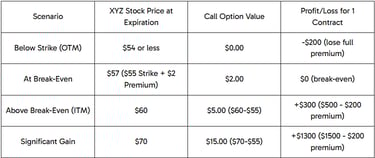
Let's say XYZ stock is currently trading at $50 per share. You are very bullish and expect it to go up significantly.
You buy 1 XYZ $55 Call option expiring in 3 months for a premium of $2.00 per share (total cost: $2.00 x 100 shares = $200).
1.2 Buying Puts: Expecting a Downside Move (Long Put)
Risk and Reward Profile:
Maximum Risk: Limited to the premium paid (per contract).
Maximum Reward: Substantial, as a stock can fall to $0 (though it's capped at the strike price minus premium paid).
Break-Even Point: Strike Price - Premium Paid
Example: Buying a Put Option
Let's say ABC stock is currently trading at $100 per share. You are bearish and expect it to drop.
You buy 1 ABC $95 Put option expiring in 3 months for a premium of $3.00 per share (total cost: $3.00 x 100 shares = $300).
Important Considerations for Buying Puts:
Time Decay: Just like calls, time decay works against put buyers. The stock needs to fall quickly enough.
Strike Price Choice: Similar to calls, a lower strike (more OTM) is cheaper but requires a larger drop. A higher strike (more ITM or ATM) is more expensive but requires a smaller drop to be profitable.
Buying a put option is the primary way to use options to profit from a falling stock price. It's often used for speculation or as an "insurance policy" for stocks you own (which we'll discuss next).
What it is: You purchase a put option contract, giving you the right to sell 100 shares of the underlying stock at a specific strike price on or before the expiration date.
When to use it (Market View): You are bearish on the underlying stock. You believe its price will decrease significantly (below the strike price) before the option expires.
Why use it over Short Selling Stock?
Defined Risk: Your maximum loss is limited to the premium you pay for the option. This is a huge advantage over short selling stock, which has theoretically unlimited risk.
Leverage: Similar to calls, you control 100 shares for a smaller upfront cost.

Important Considerations for Buying Calls:
Time Decay: This is working against you. The stock needs to move up before the option loses too much time value.
Strike Price Choice: Choosing a higher strike (more OTM) means a lower premium but requires a larger move in the stock to become profitable. Choosing a lower strike (more ITM or ATM) means a higher premium but requires a smaller move.

